Passage from the text:
"But Thou, being the Good, needing no good, art ever at rest, because Thou Thyself art Thy rest. And what man will teach man to understand this? Or what angel, an angel? Or what angel, a man? Let it be asked of Thee, sought in Thee, knocked for at Thee; so, even so shall it be received, so shall it be found, so shall it be opened. Amen."
- Book XIII Chapter XXXVIII
Commentary:
No one can understand this "rest" of God. Heaven, to be sure, is what Augustine is referring to here. I agree. Busy bee that I am, I, personally, find it hard to rest even on Sundays! While that commandment was given for my benefit, I do a bad job of obeying it sometimes. Now, prudence in mind, Sundays are not "veg-out" selfish days meant to be completely void of any conceivable work- that's devolving into legalistic extremism. What am I trying to say? Well, just what Augustine is saying; I'm so one-minded and blind that I forget to rest- not out of negligence but out of a desire to work. God is the only one that can bring me back to reality- a reality in which repose is present as far as Augustine's logic goes.
The only reasonable ending to Augustine's autobiography/memoir is a sincere, well placed, "Amen."
Friday, February 22, 2013

Convoluted or Philosophical?
Passage from the text:
" For altogether as Thou art, Thou only knowest, Who art unchangeably, and knowest unchangeably, and willest unchangeably. And Thy Essence Knoweth and Willeth unchangeably; and Thy Knowledge Is, and Willeth unchangeably; and Thy Will Is, and Knoweth unchangeably. Nor doth it appear just to Thee, that as the Unchangeable Light knoweth Itself, so should It be known by that which is enlightened and changeable. Therefore unto Thee is my soul as "land where no water is," because as it cannot of itself enlighten itself, so it cannot of itself satisfy itself. For so is the fountain of life with Thee, like as in Thy light we shall see light."
- Book XIII Chapter XVI
Commentary:
By the end of the book, the reader is clued in to the fact that Augustine understands a great deal about God. What does he understand about God? That only God can know His unknowable self. While this sounds like some mental gymnastics, Augustine believes it to be true- in a way that is as complicated as it is obscure. What reasons does Augustine have for sharing this with his audience? For none other than the evangelization of souls wandering aimlessly through life, looking for meaning, as Augustine once did.
" For altogether as Thou art, Thou only knowest, Who art unchangeably, and knowest unchangeably, and willest unchangeably. And Thy Essence Knoweth and Willeth unchangeably; and Thy Knowledge Is, and Willeth unchangeably; and Thy Will Is, and Knoweth unchangeably. Nor doth it appear just to Thee, that as the Unchangeable Light knoweth Itself, so should It be known by that which is enlightened and changeable. Therefore unto Thee is my soul as "land where no water is," because as it cannot of itself enlighten itself, so it cannot of itself satisfy itself. For so is the fountain of life with Thee, like as in Thy light we shall see light."
- Book XIII Chapter XVI
Commentary:
By the end of the book, the reader is clued in to the fact that Augustine understands a great deal about God. What does he understand about God? That only God can know His unknowable self. While this sounds like some mental gymnastics, Augustine believes it to be true- in a way that is as complicated as it is obscure. What reasons does Augustine have for sharing this with his audience? For none other than the evangelization of souls wandering aimlessly through life, looking for meaning, as Augustine once did.
Friday, February 15, 2013
Augustine, the Humble
Passage from the text:
" I listen to all these arguments and give them thought, but I will not engage in wordy disputes, such as can only unsettle the minds of those who are listening. The law is intended for edification, and it is an excellent thing, where it is applied legitimately, because its end is charity, based on purity of heart, on a good conscience and a sincere faith. Christ our Master well knows which are the two commandments on which, he said, all the law and the prophets depend. O my God, Light of my eyes in darkness, since I believe in these commandments and confess them to be true with all my heart, how can it harm me that it should be possible to interpret these words in several ways, all of which may yet be true?"
- Book XII Chapter XVIII
Commentary:
This passage says much about the character of St.Augustine. Not only is he legitimately righteous, but he is also completely humble. Augustine acknowledges the fact that for truths both so divine as to be obscure and indeterminable and so basic as to be commonplace and mundane that there may be alternate interpretations of the scriptures in which these truths are revealed. In an age when so many people cling to Christian dogma with an iron, narrow and scrupulous, grip this message is almost revolutionary. How avante garde this saint wasp; He accepted the possibility of having to share his concept of what is proper or true to the point of being free of the insularity that would cripple him in an effort to be infallible.
I Want To Know
Passage from the text:

"In what way, then, do you, Ruler of all that you have created, reveal the future to the souls of men? You have revealed it to your prophets. But how do you reveal the future to us when, for us, the future does not exist? Is it that you only reveal present signs of things that are to come? For it is utterly impossible that things which do not exist should be revealed. The means by which you do this is far beyond our understanding. I have not the strength to comprehend this mystery, and by my own power I never shall. But in your strength I shall understand it, when you grant me the grace to see, sweet Light of the eyes of my soul."
- Book XI Chapter XIX
Commentary:
I'm not too anxious about my college decision letters. But I want to know: am I accepted? Or not? Augustine alludes to a theory that we can know the future by looking at the present in the qualities and states of that which is looked upon. This is in accordance with human reason, though, and has little do with supernatural uncovering. According to Saint Augustine the future does not exist- yet- and, he argues, how can one know what does not exist? In my mind I have created an construct; my college decision already exists, I tell myself, I have just yet to know what it is. The admissions officers might not have even discussed my application or placed the acceptance letter in the envelope but I am so certain that the decision exists in such a way that though it does not exist, the very essence of its potential existence excites in me desire to know. Yes, we impatient human beings have a hard time dealing with the facts of things in the future and often in the present as well.
?
Friday, February 8, 2013
She Can Judge For Herself
Passage from the text:
"'Now you drink water because you are not allowed to have wine. But when you are married and have charge of your own larders and cellars, you will not be satisfied with water, but the habit of drinking will be too strong for you.' By making rules of this sort and using here influence she was able to keep the natural greediness of childhood that they no longer wanted what it was not correct for them to have."
Commentary:
The above is sagacious advice from a woman who has been around the wine bottle, herself, a few times. Yes, Augustine's mother had a drinking problem in her youth and this wise admonishment comes from her. But why is this significant? Because everyone needs a thorn in their side- some weakness that, initially, cannot be overcome. Such things keep us humble enough to know that we rely upon something else besides our own strength. Having experienced her own trials, Monica was fully qualified, then, to pray for her son's conversion unceasingly as the distraught widow she was.

"'Now you drink water because you are not allowed to have wine. But when you are married and have charge of your own larders and cellars, you will not be satisfied with water, but the habit of drinking will be too strong for you.' By making rules of this sort and using here influence she was able to keep the natural greediness of childhood that they no longer wanted what it was not correct for them to have."
Commentary:
The above is sagacious advice from a woman who has been around the wine bottle, herself, a few times. Yes, Augustine's mother had a drinking problem in her youth and this wise admonishment comes from her. But why is this significant? Because everyone needs a thorn in their side- some weakness that, initially, cannot be overcome. Such things keep us humble enough to know that we rely upon something else besides our own strength. Having experienced her own trials, Monica was fully qualified, then, to pray for her son's conversion unceasingly as the distraught widow she was.
?
Passage from the text:
"O God, who are so good, what is it that makes men rejoice more for the salvation of a soul for which all had despaired, or one that is delivered from great danger, than for one for which hope has never been lost or one which has been in less peril?"- Book VIII Section III
Commentary:
I think this quote is interesting if only for the fact that it's a poignant, introspective, question indicative of the rest of Augustine's Confessions. He uses them alot. Like alot. Yes, Augustine was certainly a teacher of rhetoric! The questions are also a tool used to lead the reader towards the implied conclusions- which is useful for Augustine who didn't just write the book for laughs. Augustine wanted to lead his audience on the same journey he had embarked on at the beginning of his life. This might also be why the saint aides each account of his life with extensive explanations and musings.
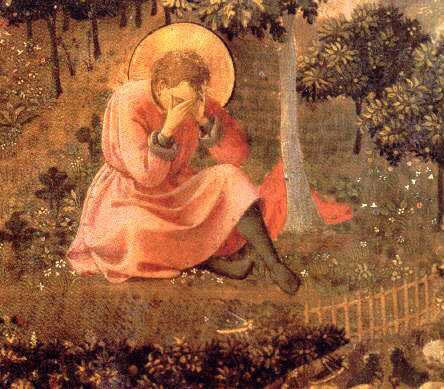
"O God, who are so good, what is it that makes men rejoice more for the salvation of a soul for which all had despaired, or one that is delivered from great danger, than for one for which hope has never been lost or one which has been in less peril?"- Book VIII Section III
Commentary:
I think this quote is interesting if only for the fact that it's a poignant, introspective, question indicative of the rest of Augustine's Confessions. He uses them alot. Like alot. Yes, Augustine was certainly a teacher of rhetoric! The questions are also a tool used to lead the reader towards the implied conclusions- which is useful for Augustine who didn't just write the book for laughs. Augustine wanted to lead his audience on the same journey he had embarked on at the beginning of his life. This might also be why the saint aides each account of his life with extensive explanations and musings.
Friday, February 1, 2013
That Theatrical Drama Makes Us Less Human
Passage from the text:
"Can I, then, love in another what I hate in myself, though both of us are human?"
- Book IV Chapter XIV
Commentary:
I felt this question was especially compelling; it's couched right in the middle of a discussion on why Augustine derives pleasure from the sadness of actors in a play, yet dislikes being sad. It's a testament to humanity's inconsistencies. Personally, I think that I enjoy drama and tragedy because, in a way, I can feel all the anguish of the fictive protagonist without any of the pain; I get to live another life without any of the consequences. Not only that, but if it's an especially badly done work, I know that the ending will be better than the beginning- and so I risk very little in letting the production tug at my pathos. My only qualm with any of the above is that in thinking that pity being drawn out of me is a form of entertainment I become desensitized to the actual occasions of unhapiness in life [or worse, begin to seek them out so as to feel picturesque and complicated].

"Can I, then, love in another what I hate in myself, though both of us are human?"
- Book IV Chapter XIV
Commentary:
I felt this question was especially compelling; it's couched right in the middle of a discussion on why Augustine derives pleasure from the sadness of actors in a play, yet dislikes being sad. It's a testament to humanity's inconsistencies. Personally, I think that I enjoy drama and tragedy because, in a way, I can feel all the anguish of the fictive protagonist without any of the pain; I get to live another life without any of the consequences. Not only that, but if it's an especially badly done work, I know that the ending will be better than the beginning- and so I risk very little in letting the production tug at my pathos. My only qualm with any of the above is that in thinking that pity being drawn out of me is a form of entertainment I become desensitized to the actual occasions of unhapiness in life [or worse, begin to seek them out so as to feel picturesque and complicated].
"It's Your Fault That I'm This way"
Passage from the text:
"But I was all words, and stupidly I used to ask them, 'If, as you say, God made the soul, why does it err?' Yet I did not like them to ask me in return, 'If what you say is true, why does God err?'"
- Book IV Chapter XV
Commentary:
At first I had to re-read the above as it made no sense at all upon first glance. But then, what sense it did make! St.Augustine, here, was being the big shot orator and arguer that he is, questioning the 500 A.D. Christians of Carthage about the perfection of God. The line of thought goes: if God is perfect, what he makes should also be perfect. Why, then, are we not perfect? This alone would be a sure-fire argument against the existence of God. But, unlike many modern-day Christians, those persons that Augustine poses the question to are astute enough to know that the two things, God and creation, are independent of each other when it comes to qualities like goodness or perfection. I think it's a clever little repartee worthy of musing: We're not perfect and it's not God's fault.
"But I was all words, and stupidly I used to ask them, 'If, as you say, God made the soul, why does it err?' Yet I did not like them to ask me in return, 'If what you say is true, why does God err?'"
- Book IV Chapter XV
Commentary:
At first I had to re-read the above as it made no sense at all upon first glance. But then, what sense it did make! St.Augustine, here, was being the big shot orator and arguer that he is, questioning the 500 A.D. Christians of Carthage about the perfection of God. The line of thought goes: if God is perfect, what he makes should also be perfect. Why, then, are we not perfect? This alone would be a sure-fire argument against the existence of God. But, unlike many modern-day Christians, those persons that Augustine poses the question to are astute enough to know that the two things, God and creation, are independent of each other when it comes to qualities like goodness or perfection. I think it's a clever little repartee worthy of musing: We're not perfect and it's not God's fault.
Subscribe to:
Posts (Atom)